Waarom 77% van loyaliteitsprogramma’s faalt (en hoe jouw brein de sleutel is tot succes)

Waarom blijf je terugkomen naar die ene koffiezaak, ook al is er een goedkopere om de hoek? Het is niet de spaarpas. Het is niet de korting. Het is hoe ze je naam kennen, hoe je je voelt als je binnenstapt. Dat is geen toeval, dat is neurowetenschap.

In dit artikel lees je hoe merken emotionele loyaliteit kunnen opbouwen door gebruik te maken van Merkle’s Human Connection Layers en de DOSE-methodiek, gebaseerd op neurowetenschap en gedragspsychologie.

Verder dan Transacties

Traditionele loyaliteitsprogramma’s richten zich vooral op gedragsprikkels, rationele beloningen die herhaalaankopen stimuleren. Toch slagen deze programma’s er vaak niet in om een betekenisvolle relatie op te bouwen. Sterker nog, 77% van de transactionele loyaliteitsprogramma’s faalt binnen twee jaar (Capgemini, 2021). Emotionele loyaliteit daarentegen speelt in op diepere psychologische drijfveren zoals vertrouwen, plezier en gedeelde waarden, en creëert zo veerkrachtige klantrelaties.

Merkle’s aanpak, Human Loyalty, onderscheidt twee kernroutes:

  • Gedragsloyaliteit: Gedreven door rationele waarde-uitwisseling (punten, kortingen, enz.)
  • Emotionele loyaliteit: Gedreven door emotionele connectie (merkwaarden, vertrouwen, plezier)

Wat hierbij opvalt, is dat merken die zich uitsluitend richten op transacties, vaak over het hoofd zien dat echte loyaliteit ontstaat wanneer klanten zich emotioneel verbonden voelen met een merk. Het is deze verbinding die klanten niet alleen terug laat komen, maar hen ook verandert in ambassadeurs.

Merkle’s Human Connection Layers

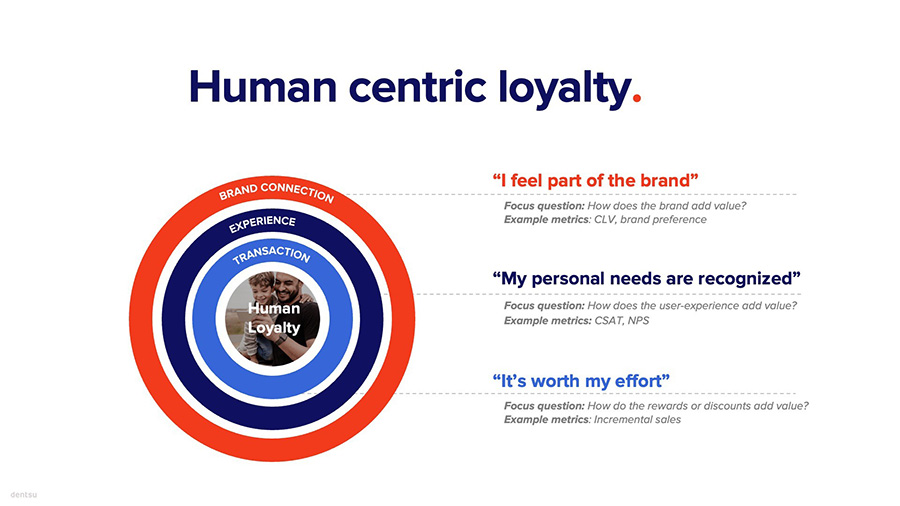
Het Human Connection Layers-framework biedt een gestructureerde manier om emotionele loyaliteit op te bouwen langs drie dimensies:

Merkle Human Loyalty

Deze lagen zijn niet losstaand, maar versterken elkaar. Een klant die zich herkent in de waarden van een merk, zal sneller positieve ervaringen opdoen en ontvankelijker zijn voor beloningen. Andersom geldt dat een soepele, plezierige ervaring de deur opent naar een diepere emotionele band.

De Neurowetenschap van Emotionele Loyaliteit: DOSE

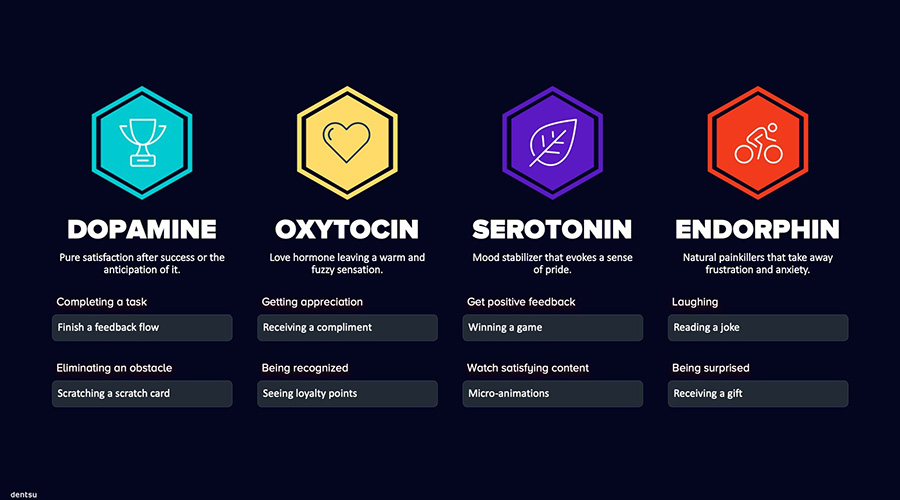
Om écht impact te maken, moeten merken begrijpen hoe emoties werken in het brein van de consument. Hier komt de DOSE-methodiek in beeld: Dopamine, Oxytocine, Serotonine en Endorfine. Deze vier neurotransmitters vormen samen de chemische basis van menselijke verbondenheid en geluk.

  • Dopamine: Dit ‘beloningsstofje’ wordt geactiveerd door verwachting en verrassing. Merken kunnen dopamine stimuleren door gamificatie, onverwachte aanbiedingen of het zichtbaar maken van voortgang (zoals spaarkaarten of badges).
  • Oxytocine: Ook wel het ‘knuffelhormoon’ genoemd, versterkt gevoelens van vertrouwen en verbondenheid. Merken die transparant zijn, empathie tonen en communities bouwen (denk aan exclusieve events of ledenvoordelen), activeren oxytocine.
  • Serotonine: Dit stofje is gelinkt aan status en erkenning. Door klanten te belonen met persoonlijke berichten, VIP-niveaus of sociale bewijskracht (zoals reviews), voelen zij zich gezien en gewaardeerd.
  • Endorfine: Geassocieerd met plezier en ontspanning. Merken die humor inzetten, positieve verhalen delen of zorgen voor een vlekkeloze ervaring, laten klanten letterlijk beter voelen.

Merkle Dose 4 hormones De Neurowetenschap van Emotionele Loyaliteit DOSE

Door deze inzichten slim toe te passen, kunnen merken niet alleen rationeel maar vooral emotioneel het verschil maken. Het is de kunst om op elk contactmoment een van deze ‘gelukshormonen’ te activeren, zodat klanten zich écht verbonden voelen.

DOSE-loyaliteitsaudit in 4 stappen

Stap 1: Audit je huidige programma
Map alle klantcontactenmomenten langs de 3 Human Connection layers.
Identificeer welke DOSE-triggers je nu al (onbewust) gebruikt.
Vind de gaten: welke hormonen activeer je (nog) niet?

Stap 2: Prioriteer op Basis van Impact
Transactie-optimalisatie (dopamine) = quick wins, korte termijn
Ervaring-optimalisatie (endorfine) = mid-term, schaalbaarheid
Merkverbinding (oxytocine/serotonine) = long-term, highest ROI

Stap 3: Design DOSE-Interventies
Per laag: ontwerp minimaal 2 concrete tactieken
Test met A/B experimenten (zie Advanced Dopamine document voor specifieke tests)
Itereer op basis van gedragsdata EN emotionele feedback

Stap 4: Meet Emotionele Impact
Niet alleen NPS, maar ook:

  • Emotional Net Promoter Score (eNPS)
  • Share of Wallet development
  • Voluntary engagement metrics (acties die klanten zelf initiëren)
  • Community health scores (bij oxytocine-interventies)

Het is essentieel om niet alleen te focussen op wat klanten doen, maar vooral op wat ze voelen. Door de kracht van neurowetenschap te combineren met slimme marketing, ontstaat een strategie die niet alleen werkt op papier, maar ook in het hart van de klant.

Merkle is sponsor van DDMA NEXT 2025. Meer weten over Merkle? Bezoek www.merkle.com.

Auteurs:

Fouad el Maouchi
Fouad El Maouchi
Consulting Manager | Merkle

Didric van den Borne

Didric van den Borne
Executive Experience Director | Merkle

De menselijke factor in een wereld van AI: zo blijft customer experience persoonlijk

Je wilt dat klanten ervaren dat je hen begrijpt en dat je hun situatie herkent. Niet alleen omdat dit bijdraagt aan conversie, maar vooral omdat het vertrouwen en een duurzame relatie versterkt. Elke boodschap die je verstuurt en elk contactmoment moet daarom kloppen met wie iemand is, wat iemand voelt en waar die zich bevindt in zijn reis met jouw merk.

Maar ergens onderweg is dat moeilijker geworden. Terwijl de technologie slimmer en sneller werd, raakte de menselijke toon soms op de achtergrond. Automatische campagnes die perfect getimed zijn, maar emotioneel nét niet landen. Een aanbeveling die klopt op papier, maar niet in het gevoel van de klant.

AI en automation beloven schaal, snelheid en precisie. Ze kunnen patronen herkennen die mensen nooit zouden zien. Maar technologie begrijpt niet waarom iemand twijfelt, zich ergert of juist geraakt wordt. Daarvoor heb je mensen nodig die context kunnen lezen, keuzes durven maken en empathie brengen in wat de data vertelt.

Customer experience gaat uiteindelijk over mensen. Over luisteren, begrijpen en soms ook even afwachten. Technologie kan dat versterken, maar niet vervangen. De toekomst van klantbeleving is geen strijd tussen mens en machine, maar een samenspel waarin de mens richting geeft aan wat technologie mogelijk maakt.

De belofte van AI in klantbeleving

AI en automation hebben het vermogen om customer experience radicaal te verbeteren. Ze kunnen gedrag voorspellen, voorkeuren herkennen en interacties realtime personaliseren. Bijvoorbeeld:

  • Voorspellende modellen kunnen aangeven welke klanten waarschijnlijk veel aankopen gaan doen, welke producten aantrekkelijk zijn en welke acties het risico op retouren verkleinen.
  • Automation zorgt dat aanbevelingen direct op het juiste moment in de juiste kanalen worden getoond.
  • Generative AI kan content maken die aansluit bij specifieke klantsegmenten, van gepersonaliseerde e-mail tot chat-interacties, en helpt teams om sneller relevante communicatie te leveren.

Door deze tools te combineren, kunnen merken niet alleen sneller reageren, maar ook proactief sturen op een klantreis die voelt alsof iemand hem persoonlijk begeleidt.

Personalisatie is daarbij niet langer een luxe, maar een verwachting. Volgens McKinsey verwacht 71 procent van de consumenten dat bedrijven hun communicatie afstemmen op gedrag en voorkeuren, terwijl 76 procent zegt gefrustreerd te raken als dat niet gebeurt.[1] Tegelijkertijd waarschuwt Gartner dat 64 procent van de klanten liever géén AI in klantenservice ziet dan interacties die onpersoonlijk of onnatuurlijk aanvoelen.[2]
Het laat zien dat technologie pas waarde toevoegt als ze menselijke intentie en empathie weet te vertalen.

Waar het schuurt: de risico’s van te veel automatisering

Hier komt het concept human in the loop om de hoek kijken. Het gaat erom dat mensen actief betrokken blijven bij cruciale beslissingen die de klantbeleving bepalen. Niet om technologie te vertragen, maar om haar te verfijnen, zodat automatisering menselijk blijft aanvoelen.

Rollen en taken kunnen onder andere bestaan uit:

  • Interpretatie van data en modellen:
    Waar een algoritme voorspelt dat een klant waarschijnlijk zal afhaken, ziet een marketeer misschien dat het probleem niet ligt in interesse, maar in voorraad of timing. In plaats van automatisch een korting te sturen, kiest die marketeer ervoor om de klant te informeren zodra het product weer beschikbaar is. Zo wordt data-inzicht omgezet in een actie die relevant voelt in plaats van opdringerig.
  • Beslissingen over uitzonderingen:
    Een model sluit een klant uit van een campagne vanwege lage engagementscores, maar een CX-specialist besluit die klant toch te behouden omdat er een langdurige relatie bestaat of recent een klacht is opgelost. Menselijke afwegingen voegen context toe die een model niet kan aanvoelen.
  • Controle op merkconsistentie en toon:
    AI kan duizenden gepersonaliseerde e-mails genereren, maar alleen een marketeer of copywriter voelt of de boodschap aansluit bij de merkidentiteit. Een subtiele nuance in taal, te commercieel of juist te zakelijk, kan het verschil maken tussen vertrouwen winnen of verliezen.
  • Ethische toetsing:
    AI-systemen kunnen onbedoeld vooringenomenheid reproduceren of data gebruiken op manieren die juridisch kloppen maar moreel ongemakkelijk voelen. Een data-ethicus of compliance-specialist stelt vragen als: Willen we dit? Is dit transparant voor de klant? Zo blijven personalisatie en privacy in balans.

Het is precies deze combinatie van AI en menselijke regie die schaalbare, relevante en vertrouwenwekkende ervaringen mogelijk maakt. Mensen sturen, AI versnelt. Technologie maakt het slim, de mens maakt het juist.

Praktijkvoorbeeld: voorspellende personalisatie in retail

In de mode-industrie verschuift klantloyaliteit razendsnel. Een persoonlijke ervaring is niet langer iets extra’s, maar de reden waarom een klant terugkomt of afhaakt. Veel retailers beschikken over jaren aan klantdata, maar missen de vertaalslag naar concrete actie. Er is wél data, maar geen dialoog.

De sleutel ligt in het samenspel tussen technologie en menselijk inzicht. Wanneer data scientists en marketeers samenwerken, verandert ruwe data in sturingsinformatie. In één project werden binnen enkele maanden 360-graden klantprofielen opgebouwd, die realtime werden bijgewerkt met aankopen, browsegedrag en service-interacties. Op basis daarvan voorspellen modellen welke klanten waarschijnlijk opnieuw zullen kopen, welke producten goed bij elkaar passen en welke bestellingen een verhoogd retourrisico hebben.

Toch bepaalt niet het model, maar de mens wat ermee gebeurt. Marketeers en CX-specialisten vertalen deze inzichten naar acties die passen bij de context van de klant. Soms is dat een persoonlijke follow-up in plaats van een geautomatiseerde e-mail. Soms betekent het juist níét communiceren, omdat een klant op dat moment behoefte heeft aan rust. Ook de tone of voice blijft mensenwerk, waar AI patronen herkent, begrijpt de mens nuance, merkgevoel en timing.

Het effect is merkbaar. Klanten ontvangen communicatie die aansluit bij hun intentie, niet alleen bij hun gedrag. Retourstromen dalen omdat aanbevelingen beter passen bij wat iemand zoekt. En campagnes voelen relevanter, zonder opdringerig te worden. Technologie levert de precisie, maar de mens houdt het menselijk.

De grenzen van gepersonaliseerde beleving

Hoe persoonlijker de ervaring wordt, hoe belangrijker het is om stil te staan bij de vraag: wanneer wordt relevant te veel? Technologie kan gedrag tot in detail voorspellen, maar juist die precisie vraagt om zorgvuldigheid. Wat bedoeld is als service, kan al snel voelen als sturing.

Daarom is het cruciaal om ethiek niet achteraf te toetsen, maar vanaf het begin mee te ontwerpenethics by design. Dat betekent dat modellen niet alleen worden gebouwd op nauwkeurigheid, maar ook op uitlegbaarheid en begrenzing. Bijvoorbeeld door algoritmes transparant te maken, risicovolle beslissingen te signaleren of menselijke goedkeuring te vereisen voordat bepaalde acties live gaan.

Zo’n aanpak houdt de menselijke maat in het proces. Niet omdat AI onbetrouwbaar is, maar omdat empathie en moreel oordeel niet te automatiseren zijn. Een marketeer kan zien dat een klant niet onverschillig is, maar gefrustreerd; een data scientist kan aangeven dat een model te veel gewicht toekent aan irrelevante variabelen; een CX-specialist kan aanvoelen dat stilte soms beter werkt dan nóg een gepersonaliseerde boodschap.

Door ethiek, menselijk inzicht en technologie met elkaar te verweven, ontstaat verantwoordelijke personalisatie: slim genoeg om impact te maken, maar wijs genoeg om grenzen te respecteren.

Wat generative AI toevoegt

Naast voorspellende modellen en automation biedt generative AI nieuwe mogelijkheden. Het kan contentcreatie op schaal ondersteunen, zoals productbeschrijvingen of gepersonaliseerde e-mails, die afgestemd zijn op het profiel en het moment in de customer journey. Chatbots en conversational interfaces kunnen klantvragen begrijpen en adequaat beantwoorden, terwijl menselijke medewerkers ingrijpen bij complexe situaties. Generative AI kan zelfs helpen bij scenario-analyse en simulatie, door te voorspellen welke acties waarschijnlijk de grootste impact hebben op retentie, conversie of klanttevredenheid. Dit versterkt het werk van mensen door routinetaken over te nemen, maar menselijke sturing blijft essentieel om nuance, empathie en merkidentiteit te waarborgen.

De toekomst: betekenisvolle automatisering

De boodschap is duidelijk: technologie neemt steeds meer taken over, maar menselijke betrokkenheid bepaalt de kwaliteit van de beleving. Automatisering zonder richting leidt tot efficiëntie, maar niet tot loyaliteit of vertrouwen. Door menselijke regie in de processen te integreren, ontstaat:

  • Relevantie op schaal: meer klanten een persoonlijke ervaring bieden zonder individuele aandacht te verliezen.
  • Snellere feedbackloops: inzichten uit de praktijk direct terugkoppelen naar modellen en content.
  • Verhoogd vertrouwen: klanten voelen dat ze gezien en begrepen worden, zelfs als veel processen geautomatiseerd zijn.

Kortom, AI en automation zijn middelen, geen doelen. Menselijk inzicht is het kompas dat bepaalt of technologie bijdraagt aan betekenisvolle interactie.

Technologie als hulpmiddel, mens als kompas

De toekomst van customer experience is geen keuze tussen mens of machine. Het is een uitnodiging om beide te combineren. AI kan patronen herkennen, voorspellingen doen en processen versnellen. De mens zorgt dat die voorspellingen relevant, ethisch en empathisch blijven.

Je wilt schaal en snelheid. Je wilt dat elke interactie klopt. Maar je wilt ook dat klanten zich gezien voelen. Het samenspel van mens en machine biedt die mogelijkheid. Het is de uitdaging van nu én de kans voor morgen: automatiseren met aandacht, sturen met gevoel, en technologie gebruiken om het menselijke te versterken.

Over GX
Bij GX geloven we dat technologie pas waarde krijgt als ze het menselijke versterkt. Daarom helpen we organisaties om klantdata, AI en creativiteit samen te brengen in één geïntegreerde ervaring. Van datagedreven personalisatie tot schaalbare contentproductie met generative AI, wij bouwen oplossingen die merken in staat stellen om relevant te blijven in elke stap van de klantreis.

GX is sponsor van de DDMA Customer Data Awards 2025 en DDMA NEXT 2025. Meer weten? Bezoek www.gxsoftware.com.

[1] McKinsey & Company. (2023, May 30). What is personalization?. McKinsey & Company.

[2] Gartner survey finds 64% of customers would prefer that companies didn’t use AI for Customer Service. (g.d.).

Jeroen Bouwmeester Leading Expert GX


Auteur

Jeroen Bouwmeester
Leading Expert bij GX

 

The Journey to the Golden Record: All Roads Lead to Data-Driven Decision Making

Creating a truly customer-centric marketing strategy hinges on understanding customers deeply enough to meet their needs proactively. This level of understanding requires a comprehensive, accurate, and unified view of each customer, known as the “Golden Customer Record.”

Guus Rutten is Managing Director at GX Software, sponsor of the DDMA Customer Data Awards 2024 and DDMA NEXT 2024.

Looking at marketing, and as it will evolve, the Golden Customer Record will be crucial for delivering proactive, personalized customer experiences. The Golden Record consolidates data from all customer touchpoints and systems into a single profile, providing the foundation for personalized and impactful interactions throughout the customer journey. More than a convenience, this 360° view is essential, enabling companies to deliver “the right product to the right customer in the right way,” driving higher conversion rates, reducing redundancies, and fostering customer loyalty.

Yet building and maintaining this holistic view isn’t straightforward. Customer data is often scattered across various platforms, leading to silos filled with inconsistent, incomplete, and outdated information. Marketers face a pivotal decision: which path should they take to create this Golden Record? The answer usually lies in either a pre-built Customer Data Platform (CDP) or a Composable CDP approach. Each pathway offers distinct advantages and responds differently to emerging data challenges, from navigating privacy regulations to leveraging advanced AI capabilities, as companies work to create and sustain a meaningful Golden Record.

The Customer Golden Record: Building a 360° View

At its core, the Golden Record is a single, complete source of truth for each customer. It ingests and integrates information from various data sources across the business, consolidating everything from purchase history and customer service interactions to website behavior and marketing engagement. The Golden Record not only unifies these data points but also links them back to their original sources, ensuring that updates or changes in any system are reflected accurately in the customer profile.

This 360° view allows companies to know each customer’s preferences, behaviors, and needs, making it possible to personalize every interaction. It’s essential for a customer-centric approach, which is all about delivering relevant, timely experiences that build loyalty and trust. When companies have a Golden Record, they can reduce mistakes like sending duplicate offers or incorrect product recommendations and instead focus on seamless, valuable customer interactions.

Key Trends Shaping the Golden Record and the Need for Unified Data

The latest report from Snowflake, “The Modern Data Stack 2024,” highlights three key shifts that are reshaping how brands manage customer data and approach the concept of a Golden Record.

  1. First, Data Gravity emphasizes the trend of accumulating data in centralized locations, which facilitates the creation of a unified Golden Record. This central repository acts as the “single source of truth” for customer data, ensuring consistency and accuracy in insights while helping businesses eliminate silos. This convergence of advertising and marketing technology underscores the need for a cohesive data strategy that enables all tools and platforms to access this unified source. By optimizing data deployment and streamlining fragmented data flows, brands can improve their marketing effectiveness and avoid costly inefficiencies.
  2. Second, Generative AI tools empower brands to analyze customer data in real time, leading to better predictions, tailored messaging, and more responsive customer experiences. By transforming raw data into actionable insights, generative AI enables dynamic customer engagement. Moreover, these AI-driven tools allow marketers to explore customer behaviors more deeply, adapt campaigns based on emerging trends, and refine their creative elements using real-time performance data. This capability reduces reliance on specialized expertise, making it easier for marketers to optimize their strategies and deliver hyper-personalized campaigns.
  3. Lastly, the increasing demand for privacy due to stricter data regulations compels companies to manage and protect customer data responsibly. Building a Golden Record with privacy at its core ensures that brands handle customer information securely and in compliance with current laws, reinforcing customer trust.

As businesses recognize the necessity of making data more accessible to broader groups within their organizations, there is a rising demand for compliance, real-time processing, cloud solutions, AI and machine learning, data integration, and ethical data practices. With data being expensive to store and complex to govern across multiple data stores, it is crucial to work with data where it lives. Today, instead of moving data to different applications for processing, processing capabilities are brought directly to the data, wherever it resides. This shift empowers marketers with timely, first-party insights into customer behavior and preferences.

Pre-built CDP: A Direct Route to a Unified Customer Profile

A Customer Data Platform (CDP) provides a structured and efficient method for consolidating customer data into a single Golden Record. These platforms are specifically designed to aggregate information from various sources—such as CRM systems, e-commerce platforms, and marketing automation tools—streamlining data into one cohesive view. It is important to note that a CDP in the traditional sense operates by hosting and managing this data within its own system, existing as a separate database besides your data warehouse. By offering a centralized repository, CDPs enable marketers to gain a comprehensive understanding of customer behaviors, preferences, and interactions, allowing them to respond more effectively to customer needs across multiple channels.

Advantages of CDPs in the traditional sense:

  1. Quick Setup and Unified Profiles: CDPs are built to unify data with minimal setup time. Companies can quickly create a reliable Golden Record, requiring little to no extensive configuration or specialized technical expertise. This rapid deployment makes it an attractive option for businesses eager to harness their customer data without lengthy implementation phases.
  2. Cross-Channel Activation: These platforms excel at syncing data across diverse marketing channels. This capability ensures that customer interactions remain consistent and personalized, whether a customer engages through email, advertising, social media, or in-store experiences. This seamless integration fosters a cohesive customer journey, enhancing engagement and satisfaction.
  3. Built-in Tools: Traditional CDPs come equipped with user-friendly tools and interfaces that enable marketers to manage customer profiles effortlessly. This means that even teams without significant technical skills can leverage the platform’s features, allowing for broader access and usage across the organization.

While CDPs in a traditional sense provide a robust solution for many businesses, they often operate within predefined structures that can limit customization. Companies with unique requirements or those needing flexibility may find pre-built CDPs less adaptable to their specific needs. In such cases, a composable architecture offers a viable alternative.

The Composable Approach: A Flexible, Modular Approach

A Composable CDP is an unbundled solution that collects, models, and activates customer data from your existing data infrastructure. This approach provides businesses with enhanced control and customization options, allowing them to move away from a single monolithic platform. Instead, companies can assemble a best-of-breed stack using specialized tools tailored for each component of the data lifecycle—such as data ingestion, storage, processing, and activation.

This modular setup enables organizations to construct a Golden Record that aligns precisely with their requirements, offering the flexibility to swap out or add components as their needs evolve and grow. By leveraging a composable architecture, businesses can create a customer data solution that is adaptable and scalable, ensuring they are well-equipped to handle complex data environments while optimizing their marketing efforts.

Benefits of the Composable Approach:

  1. Customized Solutions: The composable approach empowers companies to build a customer data solution that fits their unique operational needs. This is particularly valuable for businesses operating in complex data environments, where a one-size-fits-all solution may fall short.
  2. Scalability and Flexibility: Composable CDPs are designed to grow alongside the business. As data requirements change or expand, companies can easily adapt their stacks, adding or modifying components without overhauling the entire system. This scalability ensures that organizations remain agile in a rapidly changing data landscape.
  3. Best-in-Class Tools: By allowing businesses to select the most suitable tools for each aspect of the data process, composable CDPs enable organizations to leverage cutting-edge technologies, such as AI and predictive analytics. This results in deeper insights into customer behavior and preferences, leading to more informed decision-making and strategic planning.

However, a composable architecture typically requires a higher level of technical expertise to manage and integrate various tools effectively. Businesses must also invest in creating a robust Golden Record within their data warehouse or datalake – such as AWS, Microsoft Azure, Google Cloud, Snowflake, or Databricks.  This often involves custom and complex steps, which can be challenging for organizations with limited data engineering resources. In contrast, a pre-built CDP simplifies this process by providing out-of-the-box solutions, making it easier to maintain a unified customer profile without the same technical overhead.

Is Composable a CDP?

The composable approach can replicate the outcomes of a CDP—specifically, creating a unified customer profile or Golden Record—but it differs fundamentally from a CDP in the traditional sense. A pre-built CDP offers a fully integrated platform with specific capabilities designed to operate alongside your existing data infrastructure. In contrast, a Composable CDP allows you to select and integrate only the components you need directly on top of your current setup.

While a traditional CDP serves as a packaged solution for building the Golden Record, the Composable CDP approach provides significantly more customization. Essentially, both paths can lead to the creation of the Golden Record, but the methods and levels of flexibility involved differ greatly.

Conclusion: Choosing the Path to the Golden Customer Record

Marketers must build an infrastructure where every piece of customer data contributes to a comprehensive and actionable profile, ensuring a path to “Rome” where insights are always within reach. Whether you choose a pre-built CDP or a composable CDP, the end goal remains the same—a unified customer view that enables personalized customer journeys and data-driven decision-making. A pre-built CDP provides a straightforward, out-of-the-box solution that simplifies the process of managing customer data, making it accessible for a wide range of users. On the other hand, a composable CDP offers greater flexibility and customization, allowing organizations to tailor their data infrastructure to meet more complex needs and evolving business requirements. Both approaches have their strengths, catering to different organizational goals and capabilities.

Ultimately, both approaches can lead to a solid Golden Record, but the choice depends on your organization’s resources, goals, and technical capabilities. By ensuring data accuracy, supporting privacy standards, and leveraging predictive AI, companies can unlock the potential of the Golden Record to drive meaningful customer interactions and long-term loyalty.

Curious to see the golden customer record in action? Discover how Odido leveraged real-time insights from a unified data platform to streamline customer journeys, boost engagement, and drive 85% of conversions. Read the full Odido case here to learn how building a complete, accurate customer view can transform interactions at every touchpoint.

5 ways to navigate the Waves of Personalization

In today’s fast-paced, digital landscape, individuals may encounter up to 10,000 brand interactions per day. Many of these claim to be personally dedicated to you. But in the end, how many of those encounters can you truly remember? Brands are fighting for your attention and attention has become the hidden currency that shapes our lives. Much like our energy and money, we carefully allocate our attention to the people, content or experiences that earn it. But unlike these tangible resources, attention cannot be stored for future use; it’s a depleting and non-renewable asset, and brands are stepping up their game to claim it.

Building meaningful and personal connections between brands and customers is easier and yet harder than ever. Big technological and social developments have an observable effect on the playing field of companies, causing waves of personalization. With each wave come new possibilities to personalize, but ultimately the effects are gradually diminishing as other brands catch up. Companies have been riding these waves for decades, but each one seems to become increasingly difficult to surf.

Customers are more aware than ever of how their personal data is used and demand greater transparency and control over it, leading to the wave of trust. The challenge that arises from this wave is the Personalization Paradox, the balancing act between customization to meet customer needs and maintaining privacy and data security. While privacy and cookie laws are already strengthening the customer’s position, companies must also recognize that trust is not an option; it is a crucial element that forms the foundation for the success of every customer relationship.

Just when marketeers seem to have a handle on the challenge of the wave of trust, another one unfolds. Customers are seeking authenticity, emotional resonance, and trust in their interactions with brands – the wave of authenticity. This need may not sound novel, but the challenge lies further from shore, marked by ongoing AI developments that rise customer expectations once again. As marketers start to collaborate with Gen AI tooling to produce contextual and personalized experiences at an unprecedented speed, authenticity will get more attention. These experiences are personalized, but they might not feel ‘personal’ anymore to customers. Combining this feeling and the perception that the use of AI often lacks transparency, a question arises: Will customers still feel a genuine connection with your company or brand if they are mostly interacting with AI? While AI excels at delivering personalized content to you (or your bot that maybe reads or views it for you), the ability to empathize and have interpersonal communication skills is something that only humans possess. The future of keeping your customers satisfied and staying relevant as a company is about striking the right balance between AI-powered interactions and a human touch.

The importance of preparing for the next waves of personalization has never been greater. From front-line marketeers to top-line CMOs, there is a great challenge ahead to navigating new developments to build meaningful connections. Success in this evolving environment will favor marketeers who can adapt and innovate so get started with these actions:

1. Embrace new technologies but don’t get lost

Customers nowadays expect a personalized experience and technologies like machine learning, AI, and data analytics are enablers that tailor products and services to their individual needs and preferences. Companies that fail to embrace new technologies and platforms risk falling behind. The initial steps toward personalization seem relatively simple, but as technology and data processing become more complex, the associated challenges and technical requirements grow. Investing in too many technologies or complex systems can lead to inefficiency and high costs so it is important to find the right balance between technology adoption and practicality. To avoid getting lost, do not feel the need to just go “all in” on personalization all at once. Test and learn to see what works for your business so you make your investments worthwhile.

2. Keep two-way data transparency on top of the agenda

Customers of today expect full transparency within and across brand experiences. Transparency is a driver of trust and as mentioned before, companies need to understand that gaining trust is like building a long-term relationship. “Zero-party data sharing” will serve as the indicator for this relationship. Zero-party data is information that consumers willingly and proactively share with companies. For example, someone signs up for an account and answers a question about their favorite sports. In essence it is transcending conventional data collection boundaries, and adopting a model in which consumers actively participate as collaborators. Companies that can effectively collect and leverage zero-party data can provide more personalized and relevant experiences while respecting customer privacy and preferences. A win-win situation.

3. Personalization is not about cost saving

A common pitfall in personalization is equating it with automation. Rather than prioritizing a deeper connection with customers through relevant content, products and services, companies tend to be more focused on the cost-saving benefits of digitization and the reduction of customer service teams. Consumers are very sensitive to performative “human” experiences that are not real so when robots pretend to be people, people get turned off. When scaling personalization with technology it often does not feel human at all. To excel in personalization, do not just integrate technology solutions into your channels. Instead, consider going the extra mile by sending handwritten notes after a purchase, welcoming customers by name when they enter a store, or offering unique and tailored recommendations via email based on a customer’s previous purchases. These efforts take investment but will pay you back in loyalty, trust and, on the long run, relationship with your customers.

4. Bring back ‘human’ in digital experiences

Rapid advancement of technology often outpaces human capabilities. While technology evolves swiftly, it is harder than ever to keep up with technology-related skills and apply these newly developed skills in your work. Only 44% of marketeers indicate to have an adequate skill set in areas such as AI and machine learning, or data analytics and data science (Ensuring current and new talent is equipped with at least a baseline of data and creative skills, while allowing room for specialism, is essential to stay relevant.

Not in every domain technology outpaces us as humans. It is very challenging for automated systems to completely replicate essential human soft skills such as authenticity and empathy. Customers’ need for authenticity is pushing marketeers to strengthen soft skills to ultimately bring the human touch back in their work. Adopting the human factor into your proposition is essential because it can help build emotional connections and trust, adapt nuances, and facilitate feedback, which in turn can increase customer satisfaction and help build lasting relationships.

A recent rebranding by Tele2 and T-mobile, now known as Odido, shows that companies see the importance of combining technology with human touch. With one of their sayings, “We laten je graag zien dat het beter kan, menselijker” (translated as “We are happy to show you that it can be better, more human”), Odidio recognizes that technological advancements are important to customer experience and their telco product, but that their human commitment for their services is what truly sets them apart.

While upgrading your skills as a marketeer, do not underestimate the power of your soft skills to give that human touch that helps set your brand apart in the eyes of your customers. Embrace and reveal your imperfections and setbacks because, in the end, it’s these experiences that make us human.

5. Do not wait for the new generation to hit the market

While many marketeers are still figuring out how to deal with Gen Z, the next generation, Gen Alpha, born between 2010 and 2024, is emerging. This generation is the first to grow up with AI, mixed reality, and spatial computing as the norm. Gen Alpha naturally embraces hybrid experiences and expects instant personalized interaction where the virtual world seamlessly interactions with the physical. Do not wait around and already start evaluating how to scale and build inclusive, comprehensive, and human-centered experiences in a fully hybrid way for this upcoming generation.

The current momentum of the wave of trust and the wave of authenticity provides brands a chance to get ahead of competition. These actions will help marketeers from all levels prepare for the waves that hit the shores already and the waves to come. Do not sit it out, but instead grab your boards to ride the waves of personalization.

Are you ready to ride the waves of personalization?

Do you want to know more about the Waves of Personalization? Download the full Waves of Personalization report.

Click here to gain access to the report.

Unable to attend the CX Summit but eager to dive deeper into the topic of Waves of Personalization? Receive the Waves of Personalization Report first by simply subscribing for the frog quarterly newsletter, and we will provide you with early access to it.

Click here to subscribe to the frog quarterly newsletter

About the author: Tim van der Galiën is Senior Manager in Customer Transformation at frog, part of Capgemini, one of the partners of the DDMA Decision Makers Network. As one of our partners Capgemini plays a significant role in the organisation of the 2023 edition of DDMA NEXT on November 30th, and our bienniel Decision Makers Breakfasts. Tickets for DDMA NEXT are available at: ddmanext.nl.

Everybody is a CMO in the future organization

Marketing leaders are always on the lookout for the latest trends and are increasingly focusing on continuously changing consumer patterns. In essence, we try to predict the future. But are we able to predict the future and create a future proof organization?

Capgemini is sponsor of DDMA NEXT and the DDMA focus theme ‘Marketing team of the future. Click here to read more interesting marketing insights from Capgemini.

Who could ever imagine hundreds (if not thousands) of delivery guys on the streets, racing against time to deliver your groceries as fast as possible? The level of expectations of consumers are rising, and so is the demand for engaging in contextualized content across channels. This means that marketing organizations need to play a different role to keep up with this pace. Organizations must become completely customer-centric; marketing should be embedded in the whole operating model. To meet the golden customer-centric standard, all employees – regardless of role – must have the customer knowledge that a marketing leader has. So, does this mean that everyone must become a CMO to create a future-proof organization?

What we see at companies

As a marketing organization, it is challenging to keep up with expectations and it means that you must rethink your modus operandi. What we see in different organizations is that functional structures have created siloed, unharmonized departments. Today’s marketing teams are often organized on a channel or category-based structure. However, because of the increasing need to adapt to customer needs and serve them with consistent and relevant content, there is a visible shift in marketing operating models. Looking at firms running at the forefront of marketing, we see the ongoing pursuit of centralizing local marketing operations to drive operational efficiency.

Tempted by the typical benefits of centralizing any business function (e.g., economies of scale, greater control), especially B2C CMOs forego the creative power installed within local offices. Moreover, by transforming traditional marketing departments into customer data hubs that continuously act on new insights or value pools, the responsibilities of the marketing department are fundamentally changing. This is as more and more firms are formalizing customer experience into official roles and functions. Hereby, transferring traditional marketing responsibilities throughout the organization, yet progressing on the marketer’s biggest asset: real-time data usage. Today’s CMO (and therefore, the marketing organization) will become more purpose-led, data-driven, human-centered, and collaborative than ever before.

The role of a CMO in the new marketing organization

The role of the CMO has evolved in new directions and expanded beyond traditional brand-building. 90% of CMOs have some level of responsibility for business strategy, its tactical execution, and business-model innovation. With the right digital tools and digitalized processes, the modern CMO can take over as orchestrator of the Connected Marketing ecosystem to drive a truly value-adding customer experience.

Understanding marketing from an ecosystem perspective reduces complexity and supports the CMO in managing in four areas:

  • Data-driven – Creation of benefits beyond brand values
  • Responsive – Collaboration between departments
  • At scale – Services rely on business and IT interplay
  • Personalized – Unified and trusted data

The six critical focus areas for a data-driven marketing environment

Keeping up with complex future marketing trends is not enough, CMOs must address the need for restructuring within their organization because of the necessity of data-driven skills, collaboration, and automation. Most firms struggle in transforming into these new-age marketing powerhouses. Therefore, we identified six focus areas critical to a CMO’s preparation for a data-driven marketing environment:

  1. Create a clear vision for the marketing strategy
    • Ensure data-driven capabilities are at the core of the strategy
    • Define the roadmap for transformation
  2. Reimagine the customer journey with real-time engagement
    • Implement a customer-data platform
    • Utilize customer-listening tools to understand the intent
    • Have a clear content-management strategy and solutions
    • Use automation tools for delivery
  3. Ensure talent is equipped with a baseline of data and creative skills while allowing for specialists
    • Recruit or upskill marketing talent
    • Focus on developing an analytical mindset
    • Upskill on digital and performance marketing
    • Develop a learning curve
    • Establish a center of excellence
  4. Accelerate collaboration across the marketing ecosystem
    • Collaborate with key functions (IT, sales, finance) and external partners
  5. Implement a framework-driven data collection process
    • Create a data collection framework
    • Consider data from emerging digital touchpoints
    • Unify internal data silos
  6. Integrate long-term brand building and short-term marketing engagements
    • Build-in brand building with short-term marketing initiatives
    • Allocate separate budgets for long- and short-term marketing engagements

What are four ways to help your organization in building a future-proof marketing organization?

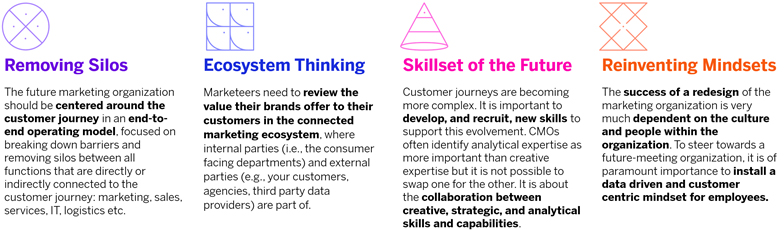
As traditional organizational structures within the marketing ecosystem must be reinvented to keep up with managing the content explosion, fast customer reactions, and technological advancements. CMOS need to train and structure their teams differently, collaborate with external partners and find the right balance between consistency and independence. The organization needs to be structured such that it supports the marketing ambitions. But how do you do that?

“Unifying your marketing organization is the first step in building future marketing ecosystem”